On Saturday, for reasons out of my control, I missed a memorial service. I did, though, get to watch it online; I’m so glad I did.
This was the stepmom of a dear friend from college, and the service was full of people, music, and remembrance of a special woman I met on a few occasions. It was one of those events where the love in the chapel was palpable, even on the screen. She did so much in her life. But what was abundantly clear was that she also WAS so much to so many. The last person to speak was her son, my friend’s baby brother. He’s a graduate of Berklee–a gifted musician and also, apparently, a gifted writer and speaker. The bookends of his speech stood out to me; they reflect so much of what this fall has been. I’ll explain.
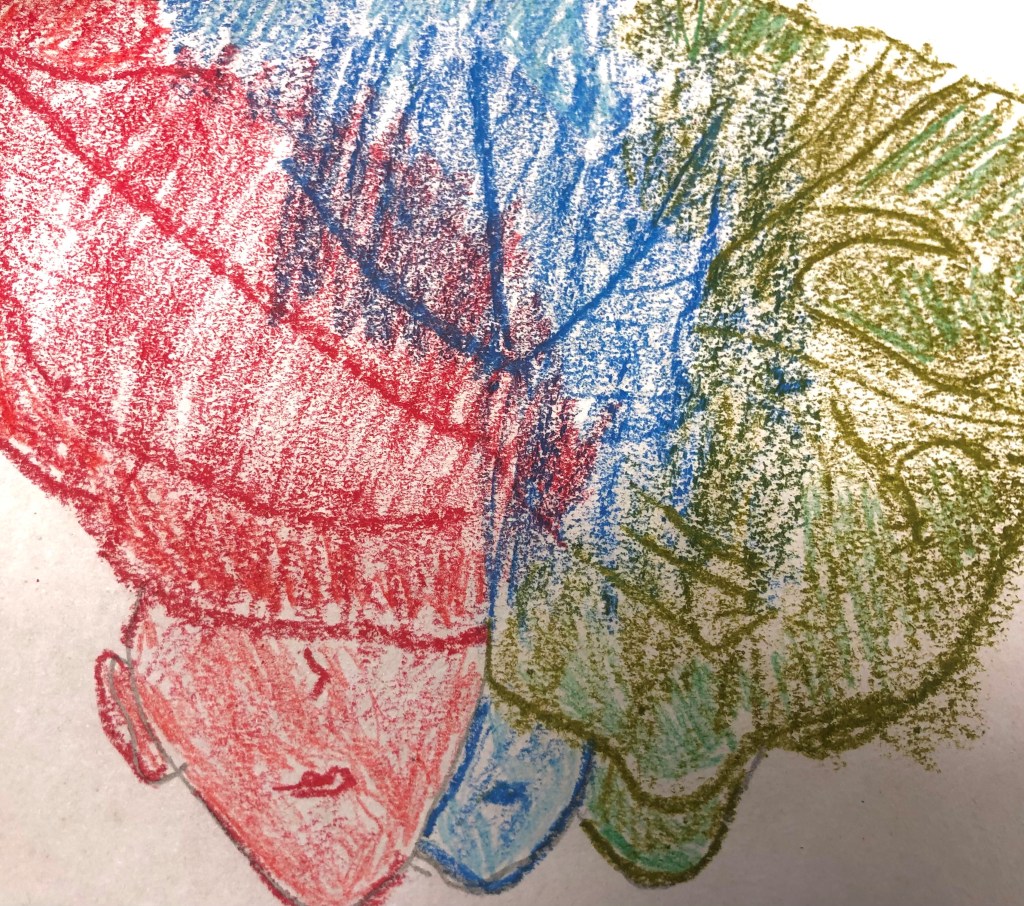
Sean, my friend Amy’s brother, began speaking about the Japanese proverb of three faces. It is, on the surface, a rather cynical view of humanity. In short, all people have three faces–the one they show the world, the one they show those closest to them, and the one they keep hidden from all. This face is supposedly their truest, known only to themselves. Sean said that his mother Sandy wasn’t like other people–that she lived her life with a single beautiful face; she was always her most authentic self, dedicated to her family, her friends, her community, and the art and music that make everything better. Her son, with the most lovely humility, pondered how special that is to be someone with one true face. How lucky he is that this person was his mother.
I have a confession to make now. I had the service on, speakers plugged in, everything projected onto my giant double screen. My laptop screen was also visible, open to my third period’s personal narratives.
It’s the end of the quarter. Everyone is under water, which isn’t unusual this time in the fall; however, it’s magnified in the fall of 2021. We all have had to relearn how to school. Only now, about nine weeks in, am I feeling a stride, a rhythm through a routine of yoga, morning pages, a walk and a half-hour drive I didn’t have to make. A routine of walking masked through crowds of bodies I’m not used to, extracurriculars I haven’t had to sponsor in person, actual physical books and papers to shuffle. If I’m feeling this way, I can only imagine the students and how they’re feeling. Only now, almost nine weeks in, I sense them in the lane beside me, hitting their stride too.
So I had Sandy’s memorial service on one screen, their narratives on “A Place Called Home” on the other. Of course, nothing got graded in the hour-and-a-half of the service. It was too beautiful. My friend and her family deserved my full attention, and they got it.
Afterwards, I clicked off the YouTube link and went back to my essays. This is when the proverb of the three faces came back to me. Writing is hard. Beyond the grammar, mechanics, sentence fluency, comma splices–just getting them to use details, to “show” instead of “tell” to quote that trope. We just finished A Raisin in the Sun, so their assignment was to think of a place they consider home, to write about that place in as vivid detail as possible and explain what makes it so special. I encouraged the active present tense, sensory imagery. I showed them models of creative nonfiction that included everything from the knobs of an oyster shell to cleaning toilets.
These past two class periods, I have been conferencing with each student on their rough drafts. Yes, I am correcting comma splices and hopefully fostering the use of more effective language. But I’m also doing something else.
I’m seeing their real faces. Here’s the thing: last year, there were some students I never laid eyes on. They were not required to turn on their cameras. I can’t tell you how many kids have come up to me in the hall since August to say hello, reminding me of their icon, an assignment they turned in, that time they typed in the chat during a movement break when I was dancing on camera with our Russian Blue…
I would lay down my life for that cat.
So maybe we did get to know each other a little bit. That’s the odd thing about the Pandemic and the Zoomosphere. The lines between home, school, and work were blurred. I know plenty of people who pride themselves on using the “two sets of keys” method for setting boundaries–one set for work, one set for home. I respect that, but I personally have always kept all my keys on one ring. My parenting, writing feed my teaching. My teaching feeds my writing and parenting. I’ve never been good at hiding my face, so I made the decision long ago not to try.
But in school, virtual or in-person, students come together and do just that–create a visage to protect themselves. Sometimes what is at home, what is inside them, is a little too real. Social media doesn’t make it any better. I’d argue it creates a fourth face even. Think about Snapchat filters for a moment if you disagree with me.
I promised my students, with this narrative assignment on home, that they could write without a filter. Yes, certain things once put into words must be addressed. Still, students had the freedom to be honest about that place, those people, who make them feel comfortable. The places and people who allow them to be themselves. The places and people they call home. For some, it was a tuna sandwich with jalapenos. For some, a cat, a cousin, the ocean, the basketball court. Student after student showed me their faces–or at least a little more of them. I am so grateful for that.
I do believe that’s how we will help each other through this–this time both miraculous and devastating–two sides of the same blade. The same face. I don’t suppose you can have one without the other. The last 20 plus months have left marks; they run the gamut from scars to blemishes to wrinkles. But maybe some of those wrinkles are laugh lines. Some of those scars and blemishes are reminders of what we’ve overcome. Something to be proud of. I don’t mind stepping out into the golden light of fall and showing my face. I feel blessed that some of my students, with their words, felt like they could do the same.


 Sally Huggins Toner
Leave a comment