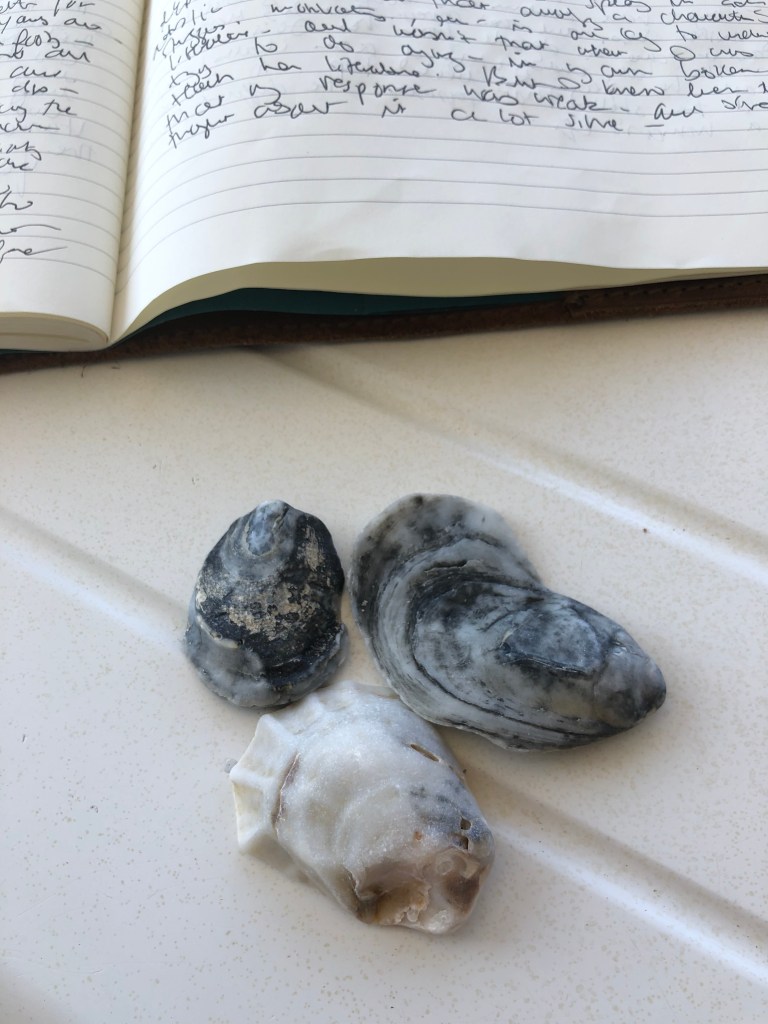
On a walk with my parents yesterday, I shell hunted beside them. It’s a long standing pastime of my dad’s in particular. He is the one who always encouraged me to slow down and notice things like dimes on the sidewalk, a salamander under a maple leaf–these visual details I appreciate so much now as I adjust to hearing loss and have to neuro-plastic myself to new intelligences and new kinds of images to fill my pages and my time. So I have slowed down, gotten better at spotting treasures like a half a sand dollar (a sand fifty cent, my husband calls it) a piece of a conch, a shark’s tooth. A few years ago, I was the first to point out the outer reaches of tentacles from a Portuguese Man-O-War. Yards down the beach, sure enough, was the colony–a floating sandwich bag filled with purple and red.
Yesterday, my parents and I walked along the water’s edge, better for finding shells tossed from the sandbar some 50 yards out. The packed surface is also more stable for our footing, and our backs, as our bodies have shifted and aged like the sand beneath the waves. The surf is rougher for all of us these days. Still, it was a beautiful morning, and I strolled the beach with my parents like I have for almost half-a-century, appreciative of my father’s patience and eagle eye like I have been for just as long. He stopped and stooped to pick up a shell. I didn’t have a chance to see what it was; I just heard his comment as he dropped it back on the sand before a wave covered our feet.
“Beautiful, but broken.”
The author Tana French said at a reading I attended once that the secret to writing characters is to first realize that we are all broken and then determine the cause of our characters’ brokenness. That made a lot of sense at the time, and I was quick to regale her wisdom to a class of AP Literature students I taught the next fall. What happened during that lesson is one of the many times in my 28 year career where I was schooled by one of the ones I was supposed to be teaching.
“That’s crap!” Emma, I’ll call her, bluntly offered. “We are NOT broken. We struggle. We are all different. But to say we’re broken is a judgement. The connotation is negative. And I refuse to be judged that way by you or anyone else.”
Oof. I think I backpedaled and tried to explain that French was speaking in an artistic sense and that analyzing a character’s struggles, motivations, etc., is one key to understanding literature. And wasn’t that what I was trying to do anyway–in my own broken way? Teach her literature? I knew even then that my response was weak. I have thought a lot about her words since.
Maybe we understand the pain of brokenness more as we age, when things like high cholesterol, ADD with the specter of inherited dementia that lurks in the next two decades, hearing loss, cancer–the list goes on. As we grow older, we don’t become less scattered, fractured. Weighed down with life’s baggage on our souls and our bodies, we don’t become any prettier.
Or do we? My father did use the word “beautiful” when he rejected that shell. And that’s the word I choose to focus on. In the past twenty years, I have become fascinated by the oyster shell in particular. I suppose I’ve always loved oysters, from the first time my grandfather squeezed lemon on top of one, smothered it in cocktail sauce, extra horseradish, and taught me how to let it slide down the roof of my mouth, down the throat, to the gullet. Eaten raw, oysters are the condensed essence of the ocean I’ve always loved. Years after I mastered the art of shucked seafood and had eaten my weight in Po Boys, my mother, sister, and I took a cross country road trip to move her into her post-college California home. Our mother brought along a CD of Claudette Colbert’s reading of Anne Morrow Lindbergh’s Gift from the Sea, and we listened to it in the car.
I might have mentioned this book in my blog before. My mother says, and she’s correct, that every woman should read it once a decade from her 20’s on. In the book, Lindbergh, wife of aviator Charles Lindbergh, recalls her yearly two-week trip to the beach and the shells that represent different phases of a woman’s life. The first, the shell of youth, is the golden sunrise. Delicate, elegant, “beautiful” in the most classic sense. The section that caught my attention though, as my forties were looming, was the one on the oyster shell. She writes:
“I am very fond of the oyster shell. It is humble and awkward and ugly. It is slate-colored and unsymmetrical. Its form is not primarily beautiful but functional. I make fun of its knobbiness. Sometimes I resent its burdens and excrescences. But its tireless adaptability and tenacity draw my astonished admiration and sometimes even my tears. And it is comfortable in its familiarity, its homeliness, like old garden gloves when have molded themselves perfectly to the shape of the hand. I do not like to put it down. I will not want to leave it.”
I have collected them ever since. They are as varied in color as shape. The darker ones, almost black, are in fact fossils. If you find them on the Hatteras seashore, or any other parkland, you are supposed to let them be. Some are white and tan, almost smooth, like a foot buried in the receding tide. My personal favorites are the ones of many colors, blue on blue, with brown and white swirled in. As irregular as they are, those are the ones that resemble the earth and its masses of land and water and clouds–so full of motion but so still when viewed from a distance. I try to see the oyster like an astronaut. Yes, as Lindbergh says, it clings to the rocks, strong against the currents of middle age, the tug of needs from generations on either side of us while our own faculties fade. Some days, I am tired. Some days I am scared of the waves, trying to fight them as the horizon and the shore both seem so far.
But this Pisces understands something about the current. There are swells that overwhelm but also plenty of moments of still. The time when the engines cut out, and I am in orbit, safe in my imagination and seeing the world, and its ugliness, from a different vantage point. If I hold on, keep my head above water, swim parallel to the shore, move with the turn of the earth, which is really quite slow when you get right down to it, I will see loveliness. And I’ll find my way back.
I will not leave the oysters; they’re my favorite–struggling, different, refusing to be judged by me or anyone else.
They are beautiful.
 Sally Huggins Toner
Leave a comment