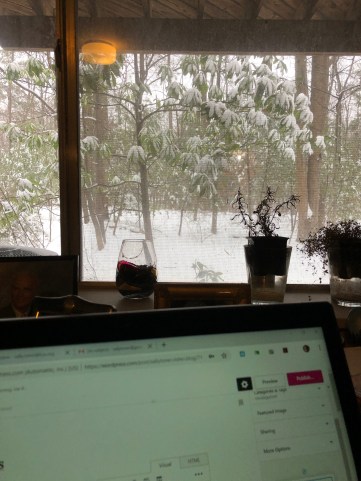
The desk in my study stands flush against a window in our walk-out basement–a view into the lower woods that separates us from Wiehle Avenue. Despite my desire for year-round tropical climes, it’s a view that may keep me in Virginia post retirement. After all, we’re sending two children to college out-of-state, and cardboard boxes deteriorate quickly on the beach.
The seasons offer colors of oak and maple green, red, yellow, and orange, families of deer, foxes, hawks, owls…I’ve never seen a coyote out of this particular window, but I’ve heard them. Today, a snow day, I’m spending the middle of the week watching sleet pock the white on the leaves of an undergrown magnolia. Nothing’s moving out there at the moment. Just my fingers on the keys inside.
I’m listening to the album Buckingham and Nicks on my turntable and grading papers. They are ekphrastic stories and essays written by my 11th graders turned in electronically.
Ekphrasis, a textual response to visual art, is often poetry. It relies on the figurative, the use of words to relay sight. Can we call it literary synesthesia? Like the number eight is always yellow, or the lower register of a cello is black and blue? I have taught journalism in addition to English for most of my career, and the narrative power of photography and art, in that context, is undeniable. I challenge anyone to walk through the collection of Pulitzer Prize winning photos in the Newseum unmoved. The written word, I must admit, has to work a bit harder to be visceral.
But it can be. When I used to teach The Grapes of Wrath, I made sure the students read the last page IN class, where I could watch them. For those of you in the know, well, you know. For the rest of you, I won’t spoil it. Find it on your shelf and start reading. The entire 300 pages is worth it for that last image, written so simply, so succinctly, so tragically. Steinbeck was writing alongside visual artists like Dorothea Lange and Gordon Parks. I saw an exhibit of his work at the National Gallery on Sunday, by the way. And I can name two or three photos that punched me in the gut in the same way the final page of Steinbeck does–every time.
“No way,” my students say. “She didn’t…he didn’t…no…”
I had just finished grading research papers over winter break when I read In Sunlight or in Shadow–a collection of short stories based on paintings by Edward Hopper. There are pieces by Stephen King, Joyce Carol Oates, all ekphrasis inspired by Hopper’s work. This reading was cool water down my throat after trudging the Sahara of Modern Language Association citation and persuasive thesis statements on social issues. Of course that is important work, and it’s part of the 11th grade curriculum. But the minutia of format. It just about killed all of us.
So my students read a piece from In Sunlight or in Shadow as an example, then chose a painting or photograph (pretty much anything was fair game) and started writing. Some of the students even used their own work, drawings and photographs. (I also advise the lit mag, and we need submissions, so my fiendish plot was afoot..mwah ha ha ha). I conferenced with them over two class periods, and final drafts were due last week.
What have I seen? A future college lacrosse star from the Southside of Chicago writing about Picasso’s Blue Guitarist. Four different students writing from the same Japanese wood etching of a giant wave overtaking a gaggle of boats. They all saw something different, from history to their own individual terror of drowning. I saw a former soccer player viewing herself as a young girl falling into a manhole as she struggles with the drudgery the sport has become. One student who wants to be a sports writer asked if he could bring in his original print of the 2013 Superbowl Champion Baltimore Ravens. Post conferencing, throughout the entire weekend, I kept receiving notifications:
“___________ has resolved comments on _______ in Google Classroom.”
Some of these notifications came on a Saturday night. And these are not AP students.
Okay, maybe they were grounded anyway and were trying to earn points for good behavior. Give me my Mr. Holland’s Opus fantasy.
The truth is, their work is good. It’s imagistic. It’s imaginative. It’s interesting.
So are they. I get tired of teacher bashing, to be sure. But I also get tired of teen bashing. This idea that our schools, our society, the high achievement culture of Northern Virginia and other areas like it, have turned this generation into pragmatic hothouse flowers lacking any ability to problem solve or entertain themselves without the digital plug-in.
Bullshit.
They want to express themselves. They have a lot to say. And they have a hell of a lot more energy than this old broad does with which to say it. I just appreciate the freedom in my classroom and the time and space to offer them models and time to do just that–to find something, art, music, dance, sports, motorcycles, goldfish–anything–that speaks to them. I want to help them find it and have a conversation. I want to help them speak back.
I want to help them find their own most magical ekphrasis.


 Sally Huggins Toner
Leave a comment