• The bIMG-5250aby looked like she could leap right into the painting behind her. She wore a red and orange onesie that meshed with the arbitrary colors—a stylized bass player in mid jam. Her eyes were sponge wide, her mother chatting constantly as they waited for someone to join them.

    I couldn’t take my eyes off the child as I sat on the second floor of the wine bar and had half-priced mussels and a bourbon, by myself, on Veterans Day.

    But this post isn’t about me. Well, okay, maybe just a little bit. We’ll get to that in a minute.

    Sitting there, watching, I remembered two other babies when they were about the same age. One of them was our oldest daughter. The Christmas after Aimee was born, my Aunt Sudy came for a visit to meet her, and we went to a travelling Van Gogh exhibit at the National Gallery. Aimee was in a cloth carrier, facing out from her father’s chest, and her gaze was that same infant sponge—mouth open with a touch of drool running down her chin. She babbled, arms outstretched, her fine shock of red hair sticking straight up like wheat before it would lay down under its weight a few months later. With her blue irises, that wild head of feather flame, that expression belonging to the artist she would become—she literally could have hopped into one of Vincent’s bedrooms in Arles.

    We bought an advent calendar that night that still hangs in her bedroom. Behind each cardboard window is a replica of one of his paintings, and there is one that she recently said always scared her. Skull of a Skeleton with Burning Cigarette. Even at his most pastoral, Van Gogh was always holding hands with death.

    Today, on Veterans Day, I want to acknowledge that every soldier does the same.

    My aunt, who was with us at that exhibit, posted the following on Facebook today:

    Lt. James Robert Vance, USMC, who served with valor. On this day, we remember him and so many others who are serving.

    Here’s where the post becomes about me, the third baby. I have multiple men in my life who have served—My grandfathers Francis Stephen Huggins and David Ashley Tompkins, my Dad, James Boyd Huggins…and another.

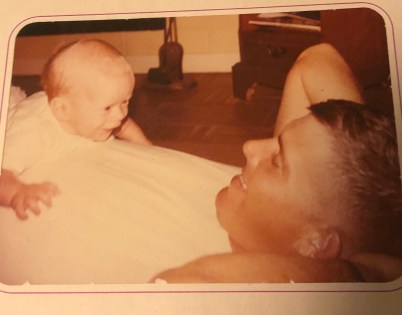
    My birth father, James Robert Vance, died in service when I was about the same age as the baby I was staring at tonight—the same age Aimee was that December her great Aunt Sudy met her for the first time.

    My mother married another pilot, and watching him look up at the sky when a jet passes overhead, I have always understood what Sudy wrote about her brother recently.

    “Jim Vance was born to fly.”

    Those who serve understand the sacrifice. But they also understand the need.

    I won’t lie. I shudder at the weapons of destruction that kill innocent people. I despise the damage of war. But I was raised to appreciate our men and women in uniform. I was raised to recognize the joy of breaking the sound barrier in an F4, the rush of catching the arresting cable with a tailhook on a postage stamp floating in the ocean.

    Yes, they are heroes. They are also fathers, mothers, sisters, and brothers. They are best friends and lovers—people whose absence, whether it be for months during deployment or forever, is felt, is mourned.

    Yes, veterans. Thank you for your service. You and everyone who loves you. I just wish, with all my heart, that we lived in a world where there was another way, another context, in which to, as the sonnet says, “trod the high untrespassed sanctity of space, put out my hand, and touch the face of God.”

    I was raised to know that, sometimes, there is not. So today, on Veterans day, I am grateful. And proud.
  • The secret to learning how to play tennis, my grandfather always said, is to find a doubles partner better than you. That axiom occurred to me on my drive into work this morning as I listened to several high powered female journalists share their experiences with and show their respect for Cokie Roberts. Station managers, international correspondents, bureau chiefs, one after the other, praised her as a principled journalist, a trailblazer, and…a mentor. Cokie Roberts has been a companion on radio and TV, making sense of an ever undulating political landscape, ever sense I can remember. But as I listened to these tributes, and mourned the loss of some old school reporting, another loss came to mind.

    If you’re as lucky as I have been, your list of examples, professional and personal, is solid—filled with people of integrity, intelligence, and depth. If you’re as lucky as I have been, there are people who challenge you with the kindest kick-in-the-ass when you need it the most. If you’re as lucky as I have been, there are people who show you how to adult.

    For me, one of those people was Melissa Joyce. She was a journalist too.

    It’s not what she ended up doing for a living. Melissa was a city planner, an activist, a mom—but before that, she was a high school newspaper editor and National Merit Scholar (though I only found that out because my mom informed me. Melissa never would have mentioned it). She was also a vegetarian, a Bob Geldof fan, and could throw an exacto knife clear across the pub lab, hitting with frightening precision a target she’d pinned to a bulletin board on the other side. (Until one of those homemade darts missed our adviser’s nose by about an inch one inopportune time she decided to check on our progress towards deadline)

    I myself had poor exacto knife skills.

    “It’s a good thing you can write, Sally,” Melissa would tease me, “Because you can’t cut a straight line for shit.”

    She’d always follow up those jabs with a huge hug before shoving a piece of pizza in my hand and making me promise, “not to work and eat at the same time.”

    That’s a rule I follow to this day. It’s a good one. As are the others she taught me. Avoid the passive voice. Don’t apologize in life or in phrases like, “It seems like…” or “What I’m trying to say is…” Be direct. Be brave. But most of all, punch up.

    You see, I was an easy target. I was two years younger, short, chubby, incredibly awkward. I tried WAY to hard (still do). Melissa could think and write circles around the cleverest, most sardonic seniors on staff. But from what I remember, where I was concerned, that pub lab was a safe space.

    “You know I have to get you ready,” she said, as she sat behind me in French class my sophomore year. “Someone needs to be editor when I’m gone.”

    It was the finest compliment I think anyone has ever paid me.

    Hazelwood, the Supreme Court decision that took power out of the hands of students and put it in that of administration, came down the year after Melissa graduated. I remember her telling me that I, “better pay f-ing attention to this. You’re going to have to write smarter and funnier to get stuff by them now.” And I did. I punched up when it was appropriate, pointing out the dangers of censorship in our libraries and mismanagement of renovations. It all got by. I had the best teacher, even though she wasn’t that much older than I was.

    We lost touch after high school. She moved out to the West Coast and then settled in the Midwest. It didn’t surprise me at all that she dedicated her life to activism and community service, to her family and friends. Our mothers are friends, so I guess that was how she found out when I was diagnosed with breast cancer. It was how I had found out,  about a decade before, when she was diagnosed. I had kept up with Melissa’s battle, her remission, her recurrence, her bravery during treatment. Then, when I got sick, about a week into chemo, I got a package from Melissa. It was a blanket. The softest I’d ever had.

    “You’ll need this.” The note said.

    She wasn’t done teaching me. Here she was, still sick herself, and she sent me that blanket. It is, honestly, a Godsend during treatment when you are always cold, your nose always running, every surface of your skin an itchy, stingy mess. She knew it all too well. When I messaged her on Facebook and asked her for her address to send a proper thank you, she sent back a smiley face with hearts, telling me it was going to be okay and to feel free to message her if I needed to vent.

    She wasn’t done teaching me.

    We’re coming up on a year since we lost Melissa.  Can I just take a moment to say…

    FUCK CANCER.

    Cokie Roberts at 75, Melissa Joyce Douglas at 51. It’s all too soon. It all sucks. There’s never enough time.

    I’m still here. Driving to school, mourning a national figure and someone who could have been. I didn’t become a professional journalist either. But I teach kids who might be some day. You better believe they’ll learn everything Melissa ever taught me.

    Because she’s not done teaching. And she’ll always be the better partner.0071420940-01-1_20181020

  • IMG-4628Happy New Year!

    It’s what my mother taught me to say at the end of every August from as early as I can remember. I’m a teacher’s kid, you see. And a teacher. The beauty of what we do is that every year is a chance to reinvent ourselves. We never lose the excitement of shopping for school supplies, picking out new pencil boxes, freshening up our magic markers. Every August, after two months off, I unlock the door to a clean classroom. Every August, at the end of the month, I will greet five or six classes of new students. Every August, on that last night before the first full day of school, I won’t sleep a wink. The night before the first day of school and Christmas Eve have always been the two guaranteed sleepless nights of the year. My outfit, carefully chosen, lies draped across the chest at the foot of the bed just like presents I haven’t seen wait under the tree.

    Okay, it’s not all enthusiasm. I also, starting about beginning of the August each year, start having the stress dreams. Those who have taught know them. You’re trying to teach a lesson, and the kids are swinging from the rafters. No one quiets down to listen to your wisdom, no matter how hard you try, no matter how much you shout. Someone may be trying to start a fire in a desk in the back of the room.

    Oh wait, that actually happened my first year teaching middle school.

    It’s been a busy summer and a productive one, for which I am most grateful. I spent time with family in North Carolina, New York, Boston, and Georgia. On that Odyssey in the land of peaches, I actually drove a VW Bug, the same make of car my father crossed the state in with my mother 50 years ago. (I think my car was in a little better shape than his, from what my mom says.) I taught my nephew how to play gin rummy and checked out an arcade in Chinatown with him and his sister, proudly watching him navigate the One Line. I wrote my other nephew a poem and got to see the first garden he ever planted. I toured the House of the Seven Gables and stood in the cemetery where Giles Corey refused to rat out his friends.

    I made art. My first published collection, Anansi and Friends, came out the first week of August. For those of you who are interested, it’s available on Amazon here , Barnes and Noble or Finishing Line Press itself. I also completed a collaboration with my friend Morgan. She’s a brilliant visual artist, and the exhibit, still hanging in the Jo Ann Rose Gallery at Lake Anne, Reston, is called Finding Home. Again, for those interested, it’s there for another week. This collection of oil paintings and accompanying poems addressing legacy, place, and rebirth began another summer years ago. I first fell in love with Morgan’s art when were neighbors, and I helped her set up a booth at the Lake Anne Farmer’s market on Saturday mornings. She’s in Arlington now, but the stars aligned, and we were able to bring her work back home. I have spent a good part of 2019 writing words to go with it. So incredibly fun.

    There will be more motion in the school year to come. We have two seniors, one in high school and one in college. Because of how recruiting works, we are fairly certain that Second Born will be heading to San Diego this time next year. Her older sister will graduate in December, and, if all goes according to plan, will apply to grad schools in performance early this spring. By this time next year, we should know where she will be as well.

    That’s the thing, though. If I’ve learned anything in almost half a century on this planet, it’s that things often DON’T go “according to plan.” In fact, they rarely do. At times, that capriciousness of circumstance breaks our hearts, for ourselves and others. Trauma is real. Grief is real. People often don’t get what they deserve, for good or for bad. But, as Fitzgerald says, “We beat on, boats against the current…”

    You had to know I’d get Gatsby in there somewhere, didn’t you? I mean, come on…it’s the first novel I have taught every year for…um…a while.

    What we’ve learned. Or, “When I was_____, I learned____.” That will be my first day activity this year. (And if any of my future students are looking me up on Twitter and find this, and it spoils the surprise, I am very sorry…and you need to get a life.)

    “When I was____, I learned____” was an activity we did at the Bridgewater International Poetry Festival in May. We were asked to choose a specific incident of learning and compose a prose poem using that scene. I have been mulling around adjusting that and meshing it with Maya Angelou’s ten point piece “I’ve Learned” to come up with something for students to consider as they begin the year. None of us comes into a situation a blank slate. We all have educational experiences, positive and negative, that shape our view, sometimes holding us back but hopefully, with a little reflection, helping us to move forward. To me, that’s what learning is. Moving forward.

    So I’m posting my version of “What I’ve Learned in my 40’s”—the model I’ve come up with to share with my classes. The last line of Angelou’s poem rings true for this veteran educator.

    “I’ve learned I still have a lot to learn.”

    So let the learning begin, for all of us.

    And Happy New Year!


    In my 40’s, I Have Learned…

    By Sally Toner

    1. Balance is a fluid thing. If you lock your knees, you’ll fall.
    2. You should watch a sunrise with a child whenever possible.
    3. We can all leap higher than we think.
    4. Anger is okay, but what we say in anger rarely is.
    5. We all need a squad.
    6. Hair grows back.
    7. I come from high places, low places, and everything in between.
    8. While cleaning up our messes, we must remember there’s always something we did right.
    9. It’s never too late to fall in love…or to learn to surf.
    10. Blood, and everything else, flows better when I unclench my fist.


  • I thought my surfing days were behind me.

    Not that they ever really existed in the first place. I’ve always been too uncoordinated, maybe a little scared. I know the ocean, though. I lived right next to it from birth until almost 14—spent my summers being tossed by waves, swallowing sand, rubbing the hard-packed stuff into jellyfish stings and spraying Solarcaine on my back so I could sleep at night. My first bee sting was at the beach, my first kiss, my first…We’ll stop there.

    For the past four years, my extended family has vacationed in the same house next to Fish Head’s Pier in South Nags Head. The family tradition of meeting at the Outer Banks actually began over two decades ago, starting in Corolla, the furthest spot on Rt 12, and moving down the entire length of the barrier islands to Hatteras and back again. I first visited Nags Head four decades ago, when family friends picked me up in Norfolk on their way down to their own extended family reunion. Or rather, they stopped to visit us for a couple of days, and my parents most likely pleaded with them to let me tag along. My mom’s friend Beverly is a saint.

    The Outer Banks in 1980 was still pretty remote—old school beach bungalows with shutter windows and screened in porches so close to the surf I’m certain they’ve fallen in by now.  No TV, just jigsaw puzzles and two windows in the front where we could watch the storms circle and slam in. I remember scanning the horizon for another hurricane wave like the one in the photo at that restaurant where I ate fried shrimp po boys. Beverly had three children, and the oldest, Maggie, was my age. We spent the week inseparable, boogie boarding, catching flounder from the shore, walking down to the pier for Ms. Pacman, Centipede, and ice cream. I went to Jockey’s Ridge (a later college beach week meet up spot) for the first time, rolled down the giant dunes. I shook sand out of my pockets for weeks.

    It. Was. Glorious.

    I read recently that these barrier islands have moved 15 to 40 miles west since the Ice Age. Coast, carved from one side, is supposed to be replaced on the other. The newest bridge to Hatteras is built about 100 yards over from the last—curved differently, engineered higher, more aerodynamic, as the older inferior technology is dismantled, bit by bit, section by section.

    I suppose that is what happens to memory. It is imperfect, structurally unsound. So we put up the red cones and bring in the cranes to deconstruct, reconstruct, our family history—our individual history. It’s the only way to move forward. We are barrier islands. Our sands must shift.

    I never learned to surf. My sisters have friends and former boyfriends for whom it is an obsession. One of them tried to teach me years ago, and I managed to sprain my toe jumping up on the board before I gave up and rode the wave in on my stomach. One sister’s boyfriend subscribed to surfing magazines, and, for a while, I read them all cover to cover, fascinated with the language, the photos, the idea of that hollow wail you hear in the tube. It’s a sound I experienced while boogie boarding in LA (after getting thrown upside down, sideways, every which way multiple times. The Atlantic and Pacific are completely different beasts.)

    The ocean at the Outer Banks is capricious in temperature and roughness, but, this year, it was fantastic. I boogie boarded again, even rode a paddle board to shore. The waves were that perfect kind—not mushy, long, rolling, crumbling and gently pushing at the very end. I considered, once again, attempting to surf for real.

    I’ve been through some stuff since the last time I tried. I’ve begun to build a new bridge—higher, more aerodynamic—and I’m dismantling, bit by bit, section by section, parts of the old one I don’t want to keep.

    I know from two years of some pretty serious yoga that balance, a key component of surfing, is a fluid thing. You must keep your core strong and never lock your knees.  I think I can do that. Who knows? Maybe there’s time yet for me to be a 50-year-old “grom.” (That’s surfing lingo for newbie.)

    There are adventures ahead. I just need to be willing to shift.

    *The pictures I’m attaching are Aimee at sunrise in the Atlantic and a surfer at dusk in Ocean Beach—the Pacific—a completely different beast.


  • 62358021_10218049505096484_8271060191127011328_o

    There’s an app I installed on my phone today.  Why?  Because this kid who used to remember what every family member was wearing on her father’s birthday in 1979—her memory might be going, and she saw some pictures on Facebook that reminded her that this was an important week, a few times over.

    I ended my 26th year of teaching this week, my 20th in the same school.  Our older daughter will enter her final year of college, and her younger sister her final year of high school, in the fall.  The oldest will turn 21, and her sister will turn 18.  Their parents will both turn 50 in the spring of 2020.

    So many numbers.

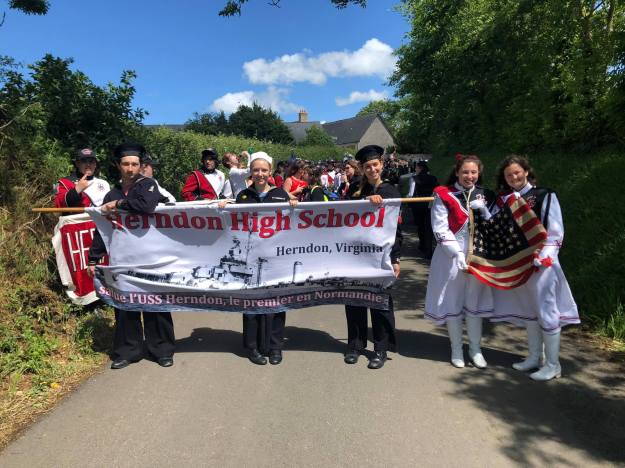
    Herndon High School, the alma mater of one child and the future one of another, held its graduation this morning.  The band that played at that graduation arrived back from Europe yesterday.  They returned from a trip commemorating the 75th anniversary of D-Day.  They stood on the beaches. They met participants. They wore their uniforms and marched with their flags. They voiced their appreciation. I witnessed their own timehop in awe on social media.

    I tell my students that numbers, in my view, are most important in context. Even this math flunkie understands that, at the highest level, the discipline becomes a philosophical exercise—an understanding of patterns and their repetition, their reverberation. It is the disruption of patterns that catches our attention. The slant rhyme of history, global and personal, that leaves us scratching our heads.

    Four years ago today, that oldest daughter I mentioned, who was a proud member of that band that went to Normandy and just played at graduation this morning, took a trip to New York City for a flute lesson. That lesson would send her trajectory, her pattern, forward to attending college in that city, applying to grad school in performance next year—you get the idea. She also happened to be in Paris this week and met up with The Pride of Herndon at one of their performances.

    Two years ago tomorrow, I had a lumpectomy to remove the remnants of a tumor. Even with my spotty memory, it’s hard to lose the voice of the tech who did my pre-surgery ultrasound: “Now where was the mass again? Oh, yeah. I see it. Ya know, that just looks like scar tissue to me.” Twenty years ago (the year I started at my present school), before clinical trials honed the effectiveness of chemo therapy, the mass most likely would still have been there, and I most likely, two years later, would not have been.

    More numbers. More context.

    Not to compare the significance of the Herndon Band’s trip to Normandy to my personal anniversary. Except to say that D-Day WAS personal. The band’s director, such an incredible teacher, role model, person, quoted one of the speeches given by her students at the ceremony on Omaha Beach.

    “Did they have someone they loved as much as I love my sister?” one high schooler said of the soldiers who stormed the same beach that day in 1944.

    Everyone’s individual timehop is personal. But no one’s timehop exists in a vacuum. Every one of us battles, and every one of us loves and is loved. So when I timehop to June 12, 2019, in what I hope is many years to come, it will be with gratitude for that love—the greatest thing in every generation.

  •  

    The lilacs outside of our townhouse gate have exploded with their dizzying purple smell.  In another month, it’ll be the pale pink roses that live right next to them.  Okay, so as much as I argue that I’m always too friggin’ cold and will need to retire in perpetual warmth, it’s hard to argue against the seasons in late April/early May Virginia.

    I tell my students that dates are important only for context.  January 4, the middle of winter, was the date when I was diagnosed with triple negative breast cancer.  May 4, the height of neon green, was the date of my last chemo treatment.

    It was a long fucking winter.

    Two years ago, I rang that bell. I actually had to supply it.  The infusion center is small.  So I brought my grandmother Huggins’ old schoolhouse bell and shook the hell out of it in the parking lot adorned with my Captain America shirt from one dear friend and a Tibetan prayer wheel from another.  Last year, I spent this weekend in San Diego with my sisters and mother on a delayed sisters’ weekend/70th birthday celebration.  This year, I took a walk around the lake with my husband.

    I also saw a movie with him on Thursday night—Amazing Grace—the film of Aretha Franklin’s live gospel recording at the New Temple Missionary Baptist Church in Watts California in January of 1972.

    Dates..context.  That was another winter.  And I can imagine it was a long fucking one for my mother.  I was two, almost three.  My birth father had been gone for a year-and-a-half, killed in an F4 at Homestead Airforce Base.  Twenty-four-year old Pam Vance was back in Virginia Beach, finishing grad school, handling a complex situation with her family in Virginia, and raising a toddler.

    At the same time, twenty-nine-year-old Grammy award winning Aretha Franklin was recording, against the advice of Atlantic Records, what would become the greatest selling gospel album of all time.

    The theater was empty on Thursday night as Mark and I watched the movie. And I said to my colleagues at lunch the next day that I can count on one hand the true manifestations of faith I have experienced in 49 years on this planet. Thursday night was one of them.  The first half of the film was pure testament, the second half pure celebration.  I was in tears for its entirety.

    My faith isn’t something I talk about much publicly.  But it’s there.  Like the lilacs, permeating, reminding me with every season that I have so very much to be grateful for—that I am so loved, so I must so love.  That’s pretty much it.

    It’s interesting to me that Aretha Franklin herself sued twice before her death to keep the film from being released.  No one knows exactly why that is.  But I have an idea.  I don’t believe this is the same situation as Harper Lee’s Watchman (writers never throw away their drafts, and that one was never meant to see the light of day…but that’s another post.)  Aretha signed a contract to let the film be made.  Sydney Pollack just messed up the technology.  Franklin was a consummate professional, and you can see that in the parts of the documentary that show the rehearsal, her little bit of sass there and the insistence of starting over once during the performance itself.

    At some point in that church, though, something else took over.  Aretha was brought up in the church.  That’s where she started singing. So she might have predicted this might happen.  Or maybe she didn’t.  She was young.  And there was a reason she chose to record that album at that time. A reason she chose that location as the place to record.  I’m extrapolating, but I’m not sure even she knew exactly what those reasons were.  I know one thing, though.  No one in that building was the same when she finished.

    I don’t think she was either.

    I wasn’t the same after Thursday night, and I only saw it on film with Dolby surround sound less than a year after we lost her.

    We don’t always want to relive, let alone make so public, these transformative experiences.

    These experiences happen, though, like the lilacs every May. They bombard us with a fragrance so powerful we have to pay attention.

    Thank Heaven for their perennial grace.

  • IMG-3501According to the latest research, the average human requires eight hugs a day for maintenance and 12 hugs a day for growth.

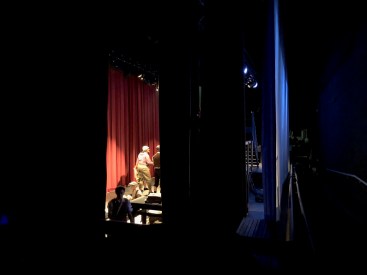
    On a related topic, when a play ends and the curtain closes, everything goes dark for a minute on the other side.  The human mass stands in black for a second, smelling of makeup and sweat, and then they cheer and embrace.

    There’s a lot of hugging in theater.

    This past week, the Broad Run theater department gave the gift of a time machine to this middle-aged broad.  Yes, I was a newspaper nerd.  But I was also a theater nerd back in the day.  At four-foot-nine, I was not the right physical type for many major roles, but I tried out for every production and, when I wasn’t cast, I did tech—which was very different in the 1980’s–basically a tape recorder and a phone ring machine activated on cue.  I worked the booth with a guy a grade ahead of me named Danny who had a full beard at 14 and I think was dating a divorcee with two small children by the time he was a senior.  One time, I lied to the director to get cast in The Madwoman of Chaillot, telling him I could juggle before teaching myself for real in the period of two weeks.  I had to toss the balls at various heights while two men discussed figures at a café table—up for the higher numbers, then down for the lower.  My performance was flawless the week leading up to opening night, including dress rehearsal.  Then I dropped balls on Friday and Saturday night.

    Oh well, the show must go on.  In fact, my first foray into the dramatic arts was in the Norfolk City Summer theater program at age 11 when I was cast as the dog in Cinderella.

    Yes, there is a dog in Cinderella.

    Who needs to be Cinderella, or a stepsister, or a fairy godmother, when you can be…

    The dog.

    There is the adage: There are no small parts, only…ahem…small people.

    Besides, they expanded the part of the dog so I could come onstage, play guitar, and sing Elvis.

    Really.

    I was also in all of the dance numbers, and if you think doing fifth position in a dog suit is easy…

    But enough about me.  That’s not what the past week was about.  What it’s been about is being a part of the magic of theater in today’s high school and the reassertion that, yes, the kids are all right.

    Broad Run had two small parts in the musical Newsises, and the director asked a colleague and me if we’d be interested in doing cameos.  “Limited rehearsal time,” he said.  “The kids would love it.”

    How could I say no?  Especially since it didn’t involve a dog suit.  I got to be Mrs. Jacoby, the tavern owner where the Newsies got their watah and seltzah.  My colleague the social studies teacher played Teddy Roosevelt.

    The week before a production, which we both needed to participate in fully, has two names.  One is “tech week,” since the kinks are worked out of lighting, sound, mics, blocking, and choreography. The choreography in Newsies was intricate, professionally managed by another colleague and some uber talented students, and—It. Was. Stunning. The other name given to this period of days?

    Hell week.

    Five-hour rehearsals, last-minute blocking changes, a fairly important ensemble member out with the flu, shouting, tears…

    And hugs.  Always, lots of hugs.

    There are theater traditions that stay backstage…the poems, the chants, the chandelier.  I’ve said too much.  I was honored, humbled, to bear witness to these young people lifting each other up.  They flew.  They literally flew.

    It’s appropriate that I’m teaching the transcendentalists in my English 11 class right now.

    It’s easy to despair in a world that is often too much with us.  I might have said this before. I’ll say it again. It is impossible to despair when I see the talent, the wisdom, the hard work, the excellence with a capital E that I observed up close this weekend.  They busted their asses.  They pushed themselves far past what they thought they were capable of.  And they did it, this cast of dozens upon dozens, together.  In the words of one of the song lyrics from the musical, just a piece of the mammoth script they memorized, “All for one and one for all.”

    I was in the bathroom putting on make-up next to a couple of cast members when they began to sing “Take on Me” by a-ha. I, of course, joined in.

    “Hey, babies, this is MY music, yo,” I teased, and we all laughed.

    it’s true.  Those girls, their voices, singing that song from 1985—MY freshman year of high school.  Damn.  Time machine activated.  The thing is, when you teach, you get to experience those high school moments every single year.  Yup, all the drama, the pain, the shouting, the tears.

    But you get to experience the magic too.  And there’s a lot of magic.  This is their time, those girls.  The world belongs to these young people who have all this talent, energy, and hope.  They pushed each other forward this weekend.  There were so many hugs.  I proclaim that the future is bright.

    Because, in the midst of drama…

    the kids are all right.

  • First, some news:  My book, Anansi and Friends is up for presale with Finishing Line Press. As I’ve said on other social media outlets, preordering is key with many small presses, so if you are at all interested in how my tribe and I, medical science, and more than a bit of luck and love smacked down the spider goddess, the pink dragon, whatever the F—you want to call her…order today. The link is here.

    Commercial over. Time to go with the flow.

    A few weeks ago, my husband sent me a link to an article: “Namaste, shitheads: ‘Rage Yoga’ combines beer, cursing, catharsis.”

    “Lololololol,” he texted underneath. It’s a joke, right?  The opposite of Namaste.

    Then my own yoga instructor cursed in class the next day, and it all made sense.

    Let me back up.  According to yoga history, the ancient gurus were extremely tall with uber long, Gumby limbs—the opposite of my 4’10” T-Rex arms.  A friend gave me my first yoga DVD almost 15 years ago, and I laughed in her face until she said—

    “Shut up, light a candle, and give it a try.”

    Since I began, I’ve defined class names by level of difficulty.

    Hatha—the kindest, gentlest—my summer class when I have the days off and can hang out with the Silver Sneaker set. (These classmates routinely kick my ass all over the studio, by the way).

    Power—taught by the perky Mommy Boot Camp instructor who tries her damndest to sneak in a little cardio.

    Vinyasa—flow…somewhere in between the previous two.

    Then my new morning instructor started talking the other week about the concept of yoga flow as it means movement from breath through fire to rest and back again. Which made me look up the definition of the term.

    “Seamless placement from one pose to the other.”

    I think it was the cursing that finally helped me make the connection after 15 years off-and-on, of shutting up, lighting a candle, and giving it a try.

    I began practicing more regularly about a year-and-a-half ago to build muscle and calm after finishing chemo and radiation.  A Good Housekeeping seal of approval from your surgeon and oncologist, as any cancer survivor knows, is far from the end of it.  So, as part of the CBT of post-treatment counseling sessions, I rediscovered yoga.  But I had never heard it put this way—as my instructor got a laugh out of the class after a particularly difficult pose.

    “When you says, ‘shit,’” she began

    “When your mind says, ‘shit,’” she continued

    “When your heart says, ‘shit,’ What do you do?”

    Shit—

    I’ll have to sit with that for a while.

    I thought.

    I’ve decided that’s where the placement, the flow, comes in.  The constant movement of Vinyasa also allows us moments of Child’s Pose, or Puppy Pose (similar to Child’s pose with arms stretched further out and a cuter name).

    Time in the fire—time to rest and reflect—but movement, flow, all the same.

    My birthday was a week ago.  I’ve begun the last year of my 40’s.  I also have several people close to me who are in the middle of the fire right now—facing trials and sadness that can be a death swaddle.  If we live long enough, we can count more than a few people we care about in that category at any given time.  We can also count more than a few people in the middle of rest, or even joy.  (That’s when you get to order a McDonald’s biscuit in the drive-through after class.)

    Still, we flow.  We burn, we rest, we rage, cry, and laugh.  Sometimes we do all of these things in the same five minutes.  That’s when Vinyasa becomes power, I suppose.

    I must remember to push through the emotional cardio to reap the benefits.

    I’m trying.  I’ll be back in class next week…

    And the week after that…

    And the week after that…

    For as long as they’ll have me.

  • IMG-3251

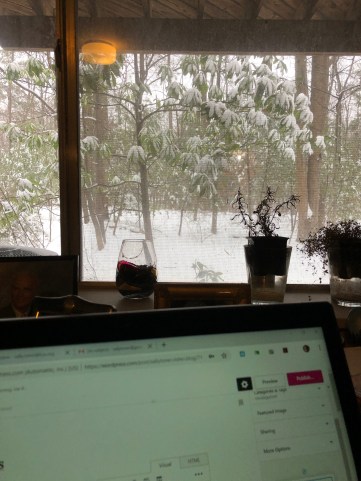
    The desk in my study stands flush against a window in our walk-out basement–a view into the lower woods that separates us from Wiehle Avenue.  Despite my desire for year-round tropical climes, it’s a view that may keep me in Virginia post retirement.  After all, we’re sending two children to college out-of-state, and cardboard boxes deteriorate quickly on the beach.

    The seasons offer colors of oak and maple green, red, yellow, and orange, families of deer, foxes, hawks, owls…I’ve never seen a coyote out of this particular window, but I’ve heard them.  Today, a snow day, I’m spending the middle of the week watching sleet pock the white on the leaves of an undergrown magnolia.  Nothing’s moving out there at the moment.  Just my fingers on the keys inside.

    I’m listening to the album Buckingham and Nicks on my turntable and grading papers. They are ekphrastic stories and essays written by my 11th graders turned in electronically.

    Ekphrasis, a textual response to visual art, is often poetry. It relies on the figurative, the use of words to relay sight.  Can we call it literary synesthesia?  Like the number eight is always yellow, or the lower register of a cello is black and blue?  I have taught journalism in addition to English for most of my career, and the narrative power of photography and art, in that context, is undeniable.  I challenge anyone to walk through the collection of Pulitzer Prize winning photos in the Newseum unmoved.  The written word, I must admit, has to work a bit harder to be visceral.

    But it can be.  When I used to teach The Grapes of Wrath, I made sure the students read the last page IN class, where I could watch them.  For those of you in the know, well, you know.  For the rest of you, I won’t spoil it.  Find it on your shelf and start reading. The entire 300 pages is worth it for that last image, written so simply, so succinctly, so tragically.  Steinbeck was writing alongside visual artists like Dorothea Lange and Gordon Parks.  I saw an exhibit of his work at the National Gallery on Sunday, by the way.  And I can name two or three photos that punched me in the gut in the same way the final page of Steinbeck does–every time.

    “No way,” my students say.  “She didn’t…he didn’t…no…”

    I had just finished grading research papers over winter break when I read In Sunlight or in Shadow–a collection of short stories based on paintings by Edward Hopper.  There are pieces by Stephen King, Joyce Carol Oates, all ekphrasis inspired by Hopper’s work.  This reading was cool water down my throat after trudging the Sahara of Modern Language Association citation and persuasive thesis statements on social issues.  Of course that is important work, and it’s part of the 11th grade curriculum.  But the minutia of format.  It just about killed all of us.

    So my students read a piece from In Sunlight or in Shadow as an example, then chose a painting or photograph (pretty much anything was fair game) and started writing.  Some of the students even used their own work, drawings and photographs.  (I also advise the lit mag, and we need submissions, so my fiendish plot was afoot..mwah ha ha ha).  I conferenced  with them over two class periods, and final drafts were due last week.

    What have I seen?  A future college lacrosse star from the Southside of Chicago writing about Picasso’s Blue Guitarist.  Four different students writing from the same Japanese wood etching of a giant wave overtaking a gaggle of boats.  They all saw something different, from history to their own individual terror of drowning.  I saw a former soccer player viewing herself as a young girl falling into a manhole as she struggles with the drudgery the sport has become.  One student who wants to be a sports writer asked if he could bring in his original print of the 2013 Superbowl Champion Baltimore Ravens.  Post conferencing, throughout the entire weekend, I kept receiving notifications:

    “___________ has resolved comments on _______ in Google Classroom.”

    Some of these notifications came on a Saturday night. And these are not AP students.

    Okay, maybe they were grounded anyway and were trying to earn points for good behavior.  Give me my Mr. Holland’s Opus fantasy.

    The truth is, their work is good.  It’s imagistic.  It’s imaginative.  It’s interesting.

    So are they.  I get tired of teacher bashing, to be sure.  But I also get tired of teen bashing.  This idea that our schools, our society, the high achievement culture of Northern Virginia and other areas like it, have turned this generation into pragmatic hothouse flowers lacking any ability to problem solve or entertain themselves without the digital plug-in.

    Bullshit.

    They want to express themselves.  They have a lot to say.  And they have a hell of a lot more energy than this old broad does with which to say it. I just appreciate the freedom in my classroom and the time and space to offer them models and time to do just that–to find something, art, music, dance, sports, motorcycles, goldfish–anything–that speaks to them.  I want to help them find it and have a conversation.  I want to help them speak back.

    I want to help them find their own most magical ekphrasis.

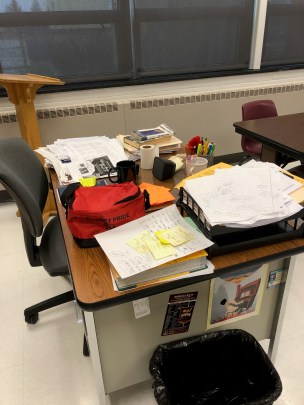
  • IMG-3199We’ve had two school day delays in a row for a glaze of ice over bridges and overpasses.  This morning, I tackled a glaze of sticky notes and papers on my desk–names, notes, editions to and deletions from Broad Run’s Fifth Annual African American Read-in.  The auditorium lights went up on our featured reader at 6:45, and I was still fixing the program and accompanying slide show at 4:20.  Twenty seven student and faculty performances, cakes, balloons, a piano, reception and book signing afterwards.

    To born organizers, none of the above sounds un-doable.  Plan, list, delegate, double check, triple check.  Piece of cake.  (Or both vanilla AND chocolate cake in our case.  We had both.)  But to me, the one who has operated with three book bags vomiting paper of various shapes and sizes since the eighth grade and presently has 131,000 emails in her inbox.  Well, you get the idea.

    Being in charge of this was terrifying.

    “But don’t forget you’re creative,” my mother always said when I never got above a satisfactory in organizational skills.  Or handwriting.  Or spelling.  Then she’d wonder aloud how I was the only Catholic school girl she’d ever known who COULDN’T spell or write in cursive worth a damn.  When our first daughter was born, I burst into tears when my husband came to the hospital and told me she was alphabetizing my spice rack and was laughing that I had at least ten containers of cinnamon.  Clearly, even as a mother myself, I had not grown out of being a beautiful mess.

    Yes, I’ll add the word beautiful.  No one ever made me feel other than that. I grew up loved for who I was, ADD and all.  They didn’t label these issues then. We were called “scattered,” “unfocused,” or, if we had the parents I was blessed with–

    Creative.

    Unique.

    But sometimes a mess.

    There are times when being a mess is red hot carelessness.  Harmful to others.  You want to see me lose my s–?  Watch me after two tenth grade boys shove each other around the hall of my school and miss this littlest teacher entirely, where I have to employ my lightning fast 49-year-old reflexes to keep from being slammed into a water fountain.

    “Hey, pay attention!” I project in my best teacher voice. (It’s much bigger than I am).  WATCH OUT BELOW.  I try to make it a joke, sometimes.  Still, they need to learn.  The messes that hurt, we have to clean them up.  Even those messes teach us something, though.  If we pay attention.

    Want to see me lose my s– in a good way?  Watch these kids who raised their voices last night.  There’s nothing I can teach them in my little room that matches the courage it took for them to get on stage, to share their feelings about everything from loveliness to heartbreak to gender identity to what it’s like, really, to be black in Ashburn.

    “How do you feel?” our featured speaker, my friend, a phenomenal spoken word poet and advocate named Camisha Jones, said on our way to her signing table.

    “That was terrifying.  But it was awesome.”

    “Those kids…” she began.

    “I know, right?”

    “Those kids.  They had something to say.  They got a chance to say it. They were heard.  That’s huge.”

    It is.  They were fearless.  In a time and place where everyone MUST make a 4.0 or higher, be on the best travel team, have the best music teacher, trainer or coach, the best of the best of everything…

    These kids of all races, creeds, and backgrounds honoring the tradition of African American literature were fearless.  They weren’t afraid to make mistakes, to miss a note or have a slide show they’d created replayed when the sound didn’t work, or stumble over a word.  They had something to say.  And they were willing to say it.  Mess and all.

    And it was beautiful.


Design a site like this with WordPress.com
Get started