 I’ve been struggling with my words for the past couple of weeks. My thoughts are encased in icy droplets of brain fog as I sift through multiple emails, CNN, and Twitter. I move to the Yoga mat or treadmill to breathe for a bit, and back again. It feels a little like being thrown into icy water, bobbing up and gasping for air.
We are frozen.
Loudoun County’s first day off from the Corona Pandemic was two weeks ago Thursday, and I opened an email that first morning that made me groan audibly. Mark looked up from his plate scrambled eggs.
“It’s from one of my cancer survivor listservs,” I explained, “Saying that survivors have so much to offer during this time. That’s bullshit. I only have a modicum of wisdom to offer even other cancer patients. Every journey is different. No outcome is the same. And this is a global pandemic. Not the same thing AT ALL.”
“Maybe not,” Mark said, thoughtfully. “But you know fear; you know uncertainty…”
And I know something else, albeit on an entirely different scale.
I know what it feels like to be frozen.
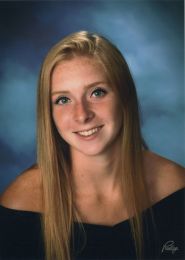
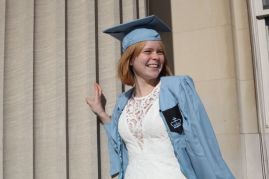
I sat in front of my computer this morning, looking at the faces of three classes of AP seniors in a Zoom meeting. Our own high school senior was upstairs, just waking up, her senior lacrosse season decimated, prom and graduation in doubt, her social life, well, physically non-existent. Her father and I were supposed to be walking across the field with her on Senior Night at the end of April. Our older daughter is holed up in an apartment in Manhattan, going on runs wearing a surgical mask. She was supposed to play alto flute in the Columbia University Orchestra’s spring concert. I was supposed to be up in New York over spring break playing a duet with her in a senior recital.
In the grand scheme of things, seen globally, we are so lucky. We are all healthy and safe. I have a sister who is a nurse taking shifts at U.V.A. Her concerns right now, on a daily basis, go far beyond graduations and virtual lesson plans. In the coming weeks, she will see up close, but I fear we all will see, this crisis in frightening perspective.
But right now, my heart is breaking for my two seniors. My heart is breaking for the 50 seniors who were on my screen this morning.
I decided to begin this first virtual class with an apology. I told them how sorry I was that they were robbed of this semester. I told them we were dealing with it in our own house as well.
And then I explained my own experience with being frozen. When a doctor’s call stopped my life in its tracks. There were lots of figures, percentages, plans, but no certainty. And life wasn’t at all normal—for a while.
In fact, what I told my students is that, if we live long enough, there will be a few times when we are frozen—when there is a before and an after. Traumatic, transformative events stop our lives in their tracks. In the midst of it, we wonder if things, if we, will ever be normal again. Then, when we come through on the other side, they are. But it’s a new normal. On the other side, we realize we have lost people, places, innocence, a part of ourselves.
We also realize we have gained something. New people, new places, wisdom, strength we didn’t realize we had.
This morning, running my fingers through my scraggly hair, I told my students that I could, if I tried, take myself back three years, to when I was weak, frightened, completely bald, wondering if that hair would ever grow back again. Looking at a timeline of nine months of chemo, surgery, radiation, wondering if it would ever end. Nine months seemed endless. Today, three weeks of social distancing seems impossible. This morning, I acknowledged living with uncertainty, realizing that we live our lives with the other shoe ready to drop.
We are frozen, all of us at once, on a scale unprecedented. We pray for the thaw. It seems unattainable—a moving finish line. And then what, we ask? When will this horrible virus pop up again. Or another one, even?
Okay, maybe I do know something about that feeling.
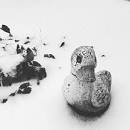
Still, we’re here. We’re video conferencing, playing music, writing, hiking, watching dogwoods and forsythia explode around us. There’s this poem in my collection Anansi and Friends called “Snow Duck on the Ides.” I wrote it after a walk in the neighborhood three years ago this very time of year. I was probably at my sickest and couldn’t make it around the lake where I live. I think we walked a sixth of a mile in the March snow before I couldn’t take another step. My husband, in his typical patient fashion, said, “You don’t have to go any further,” and he helped me back home. But I remember how frustrated I was. How much I wanted to be able to take that stroll I love so much, all the way.
We are frustrated. We are frightened. But we are also still here. And we have each other.
Maybe that’s enough for now.
Snow Duck on the Ides
I see the stone creation, smaller than
my neuropathic hand. All thumbs, I stop
and fumble a shot. He’s pocked, throat slit by sleet
and sun, but once upon a time his beak
was bright, the yellow of daffodils that cry
beside him. They’re already dead, whether
cased in glass from weather or man.
The flowerpot man on the corner flashes
with flags on the fourth of July—a Santa hat
in December; when wind or rowdy kids
destroy, they fix him to resemble human
form again. The duck is different; his grief
is real, compounded and ignored, like poison
in the veins until the statue, now
a stranger to himself stares at me
black spotted face reminding In a whisper
of precipitation, “I’m still here.”
 Sally Huggins Toner
Leave a comment